Showing posts with label Wildlife. Show all posts

Saturday, July 31, 2010

River Kingfisher

     In the eighteen years I've been in Taiwan, I've seen only three river kingfishers and then only on a total of four occasions.  Most recently was today: July 31, 2010, and I was fortunate enough to have my camera on me. 
    I had never seen a river kingfisher in Taipei County before and wasn't expecting one then.  I was stalking an unidentified heron when, through the corner of my eye, I glimpsed a flash of turquoise fly past me.  After determining the direction in which it had flown, I crept up to that spot. Upon spotting the bird I alternately took pictures and slid my feet sideways, inches at a time, to move closer.
     With the small digital camera I use, it's hard to get a clear photo of a small bird.  These pictures, which I took at Shuangxi Creek (Shuangxi Riverside Park) will have to do.
*          *          *

Monday, July 26, 2010

Chinese Bulbul

      The Chinese bulbul, also known as the white-vented bulbul, has been called one of the "three treasures of the city.  The city in question is Taipei City.  The two other treasures are the Eurasian tree sparrow and the Japanese white eye.

     Since the Chinese bulbul is a fairly small bird, if you're using an inexpensive camera, you have to get within ten meters of the bird to get a somewhat clear shot.  That's extremely difficult.  Most have been a greater distance from me and flew away before I could get close.  Some others perched within five meters of me but flew away before I could get my camera ready.
          The Chinese bulbul in these pictures was very helpful. Little by little, I got closer and closer.  I took many pictures, figuring that most of them would be blurry.  None of these pictures is as clear as I'd like, but, after all, the Chinese bulbul is a small bird.  Without professional equipment and training, a clearer picture of a Chinese bulbul may be beyond my capabilities.


     Below are some pictures I took of Chinese bulbuls while I was riding along that same trail.  I don't remember where I saw them. 

For more information on Chinese bulbuls, click here.

*          *          *

Friday, July 23, 2010

White-vented Myna

     The white-vented myna is one of the most common birds in Taipei City, but it has been very hard to get close enough to one to take a very clear picture.  I took the above picture while on a bicycle ride about five hundred yards before the Keelung River bicycle trail turns into an area flanked by wetlands on both sides.
     If you look closely, you can see the white rump (vent) and the white wing flashes.  Only when the white-vented myna is in flight can you see that the white on its wings are all along the tips of the wing feathers.  In one of the photos below you can see the white tail flash.
      In the above-left photo, we see another shot of the bird seen at the top of the page.  The white-vented myna at right is in the little park under the MRT line near the Zhishan Station.  I had thought that the moving vehicle would have startled him to flight, but, no, he just stood there and watched the car go by.  You can see the white tail flash in that photo.
      Above, you can see the same white-vented myna that watched the car a moment or so later. Again, if you click to enlarge the photo, you can see the white tail flash.
     A few years ago, I found an injured white-vented myna in that same park and took it to a veterinarian who does that kind of work for the Taipei Wild Bird Society.  I used a disposable camera to take several photos of it.   I believe I had the photos scanned.  If I did, and I can find them, I'll post them to this page.
     I took the photo below near Hsuang Shi Creek.  Dozens of white-vented mynas roost in a tree at twilight.
     For more information on the white-vented myna (unfortunately, not much more) click here.

Sunday, July 18, 2010

Eurasian Tree Sparrow


 In Taipei, the Eurasian tree sparrow is called one of the "three treasures of the city."  The other two are the Japanese white eye and the Chinese bulbul.  The Eurasian tree sparrow is one of at least three species of sparrows in Taiwan.  The other two are the house sparrow and the russet sparrow. 
For what it's worth, the English sparrow, which is common in the United States, is not a true sparrow.  It's a species of finch.  The shape of the bill is a dead giveaway.
    I saw these tree sparrows in the 228 Peace Park in Taipei.


 For more information on the Eurasian tree sparrow, click here.

Friday, July 16, 2010

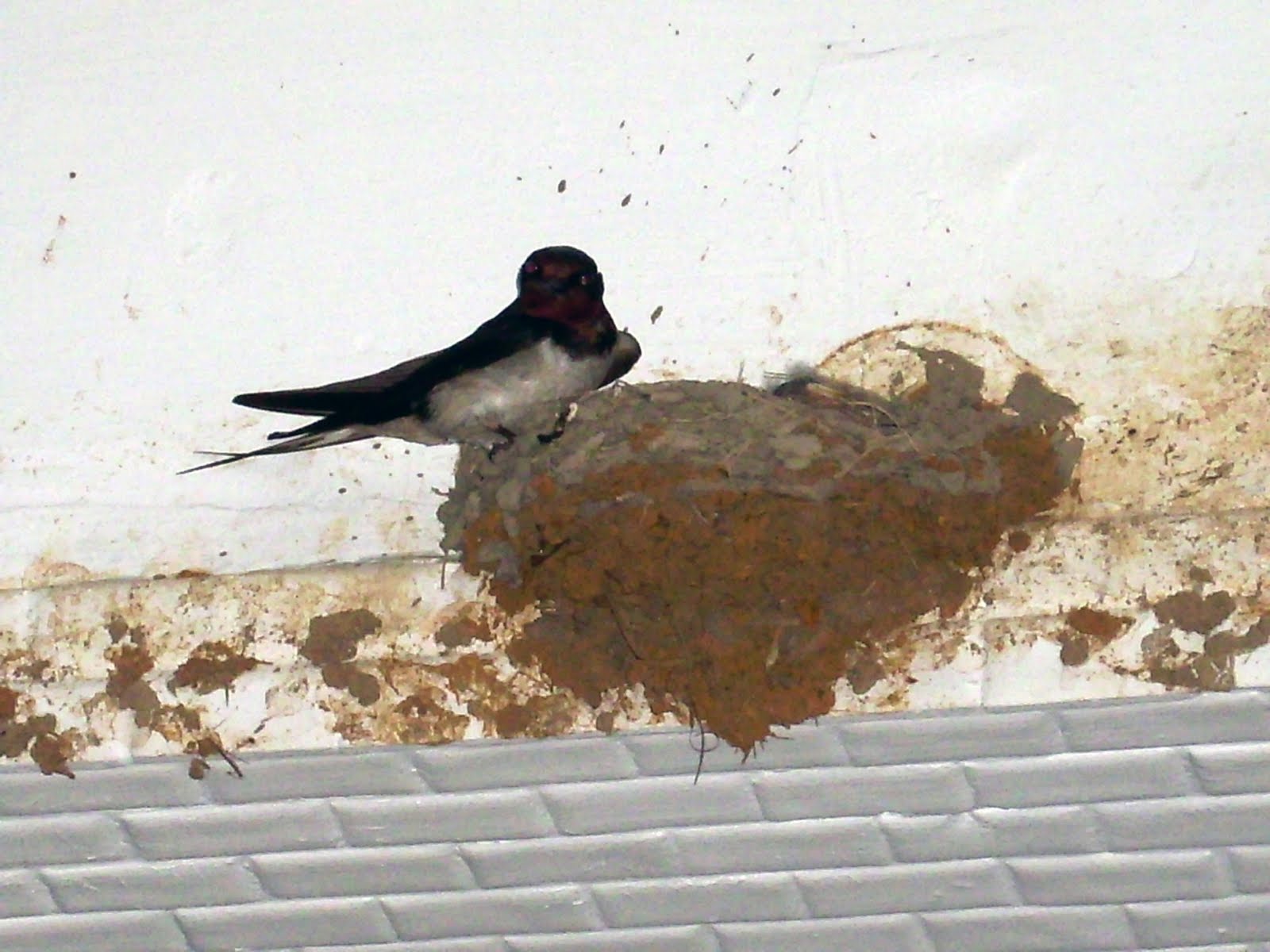
Barn Swallow


     Barn swallows arrive in Taiwan almost every March.  The winter of 2009-2010 was especially long and cold, so they didn't arrive until early April.  
     In Taiwan, it's considered good fortune to have barn swallows nesting in your eaves.  

     Although it's just a superstition, I'm happy for the belief.  The flight of swallows under building overhangs is delightful.
     Traditional Taiwanese buildings overhang the sidewalks.  That's where swallows make their nests of mud, sticks, and whatever else they can find.
     Most store managers place sheets of paper or plastic on the sidewalk under their nests to catch the poop.  Some people nail wooden ledges in place so the swallows can more easily build their nests there.  A few have callously knocked the nests down, apparently considering the birds too unclean for their liking.
     There are at least two species of swallows in Taiwan: the barn swallow and the Pacific swallow.  I've seen Pacific swallows in Hsinchu County, but I've never been able to photograph them.
(Click here for more information about barn swallows in Taiwan.)

Gray Treepie

     There's not a whole lot I can say about the gray treepie, except that the word is pronounced as though it were two words: tree and pie.  I saw this bird in Huangshi Riverside Park in the Shih Lin District of Taipei. The two photos immediately below are the same shot.  I used Photoshop to brighten the one on the right.  I also used Photoshop to zoom in on the others and make the photos clearer.
Click here for more information on the gray treepie.